
Written by Quentin McCree
Published August 14, 2026 10 minutes read
Key Takeaways
- During perimenopause, declining estradiol changes where the body stores fat — shifting it from subcutaneous storage at the hips and thighs toward visceral fat around the abdominal organs.
- Because fat is relocating rather than accumulating, body weight can stay the same while body shape and cardiometabolic risk both change.
- Hormones set the environment. Observational research associates hormone therapy use with lower visceral adiposity, though observational data cannot establish causation. Bioidentical testosterone has been reported to lower insulin resistance and support lean muscle mass, which may make visceral fat easier to reduce.
- GLP-1 medications reduce lean mass. They are effective for reducing body weight and visceral fat, but also reduce muscle — which is why resistance training and adequate protein intake matter during treatment, and why hormone optimization alongside GLP-1 therapy may help preserve muscle.
- Where to start: Resistance training, protein, and sleep are the highest-value behaviors — but they are inputs into a hormonal system. Knowing your actual hormone levels comes before another round of dieting.
The scale says the same thing it said two years ago.
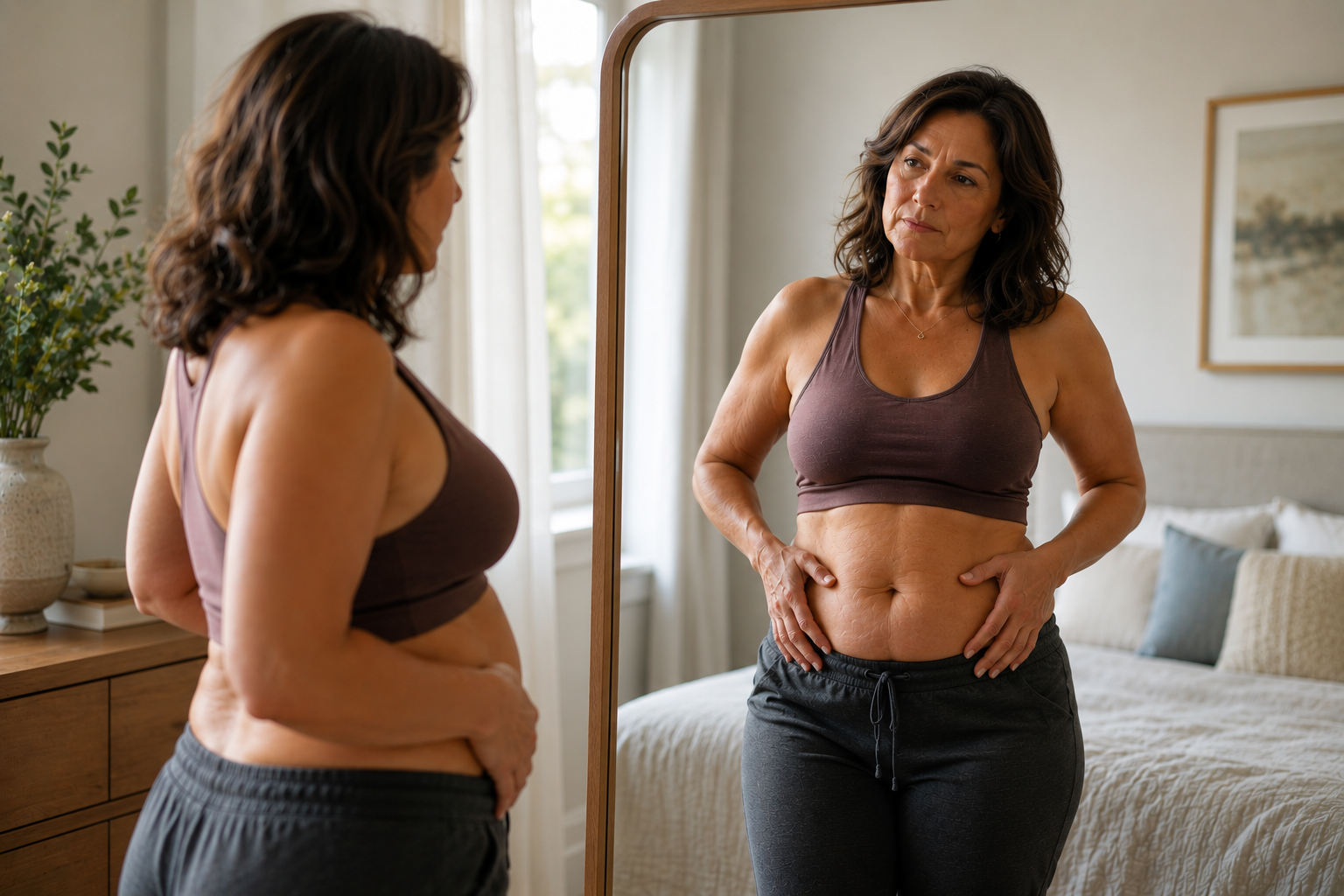
But the jeans that used to fit don't. Your midsection is soft in a way it never was. You catch yourself in a window, and something is just… off. And you've done nothing different. Same habits, same body. Except it isn't the same body anymore.
So you talk to your doctor. You get told it's stress. Or it's normal. Or it's just what happens with getting older. But you are disciplined — and you're still the same weight, feeling different. Less energy. Less motivation. Less like yourself.
Why is this happening?
Estrogen Influences How Fat Is Stored
Fat isn't stored randomly. Your body makes decisions about where it goes, and estrogen has a lot of say in those decisions.
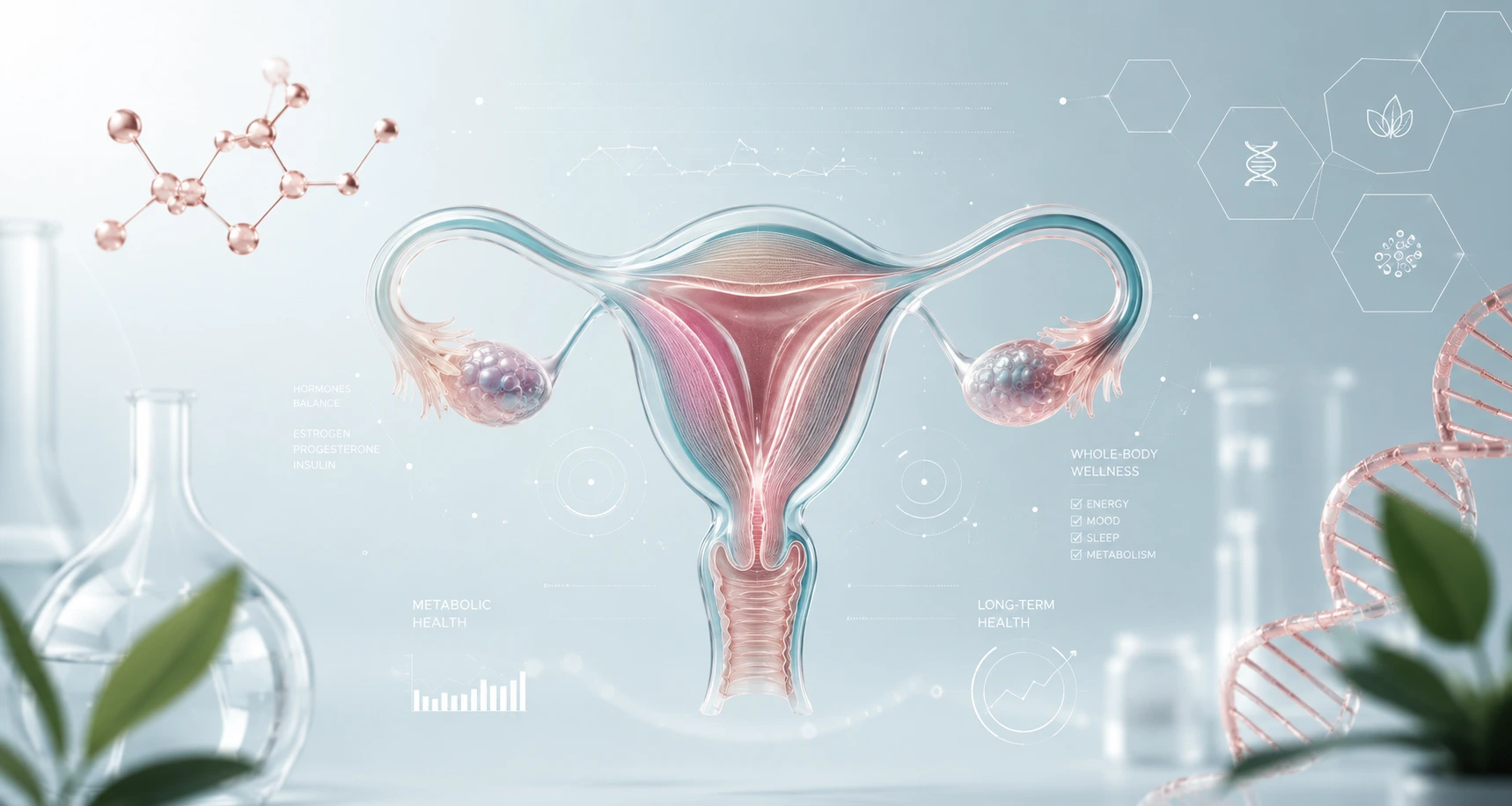
Through your reproductive years, estradiol pushed fat toward your hips, thighs, and backside — stored just under the skin as subcutaneous fat. As estrogen declines through the menopausal transition, that changes. Fat starts storing in your abdomen instead, and specifically as visceral fat: the deeper fat packed around your organs. (Mauvais-Jarvis, 2015)
Here's why that matters for the scale. Fat moving from one place to another doesn't have to weigh more. It can weigh exactly the same. The scale in your bathroom cannot read visceral fat.
And this isn't just a theory about aging. Research following women through the menopausal transition found that subcutaneous fat increased the way it does with age in anyone — but the increase in total body fat and visceral fat specifically tracked with menopause itself, not just the passing years. (Lovejoy, 2008)
Aging explains the subcutaneous fat. Menopause explains the visceral fat.
The Part Where It Compounds
Estrogen doesn't only influence where fat goes. Three other systems shift at the same time, and they all pull in the same direction.
Muscle. Estrogen supports the process that builds and maintains muscle tissue. As it declines, muscle loss accelerates. Skeletal muscle is responsible for roughly 80% of insulin-mediated glucose uptake, and it burns calories just by existing. Less muscle means a slower metabolism — same breakfast, different math. (Shulman, 2000; DeFronzo, 2009)
Insulin. Estrogen helps keep your body sensitive to insulin. As levels drop, many women develop some degree of insulin resistance, nudging the body toward storing rather than burning. (DeFronzo, 2009; Petersen, 2004)
Energy. Estrogen supports your cells' ability to produce energy and burn fat efficiently. As it declines, that capacity decreases — even when you're doing everything right. (Ventura-Clapier, 2017; Lowell & Shulman, 2005)
Here's the loop: more visceral fat, less muscle, slower metabolism, worse insulin sensitivity, less energy for the gym, more muscle loss. And the whole time, the scale barely moves — so nobody, including you, believes anything is actually wrong.
That's the trap. It isn't that you stopped trying. It's that the thing you were measuring stopped telling you the truth.
This Isn't About How You Look
Visceral fat isn't a cosmetic issue. It's metabolically active tissue associated with a higher risk of insulin resistance, cardiovascular disease, and type 2 diabetes. (Kershaw & Flier, 2004; Hotamisligil, 2006)
You're not being vain for noticing the change. You're noticing a real shift in your cardiometabolic risk. You should trust how you feel — you know your body better than a number on a scale does.
What the Research Says About Hormones and Body Composition
Observational research has found that hormone therapy use in women is associated with significantly lower levels of visceral adiposity. It's an association, not proof of causation — but it points somewhere meaningful.
Bioidentical testosterone, a key piece of women's hormone therapy, lowers insulin resistance, which in turn can help reduce visceral fat accumulation. (DeRosa, 2021) It also helps build and preserve lean muscle mass, improving metabolic rate and glucose disposal. (Traish & Morgentaler, 2022) More muscle creates a better fat-burning environment — making visceral fat easier to reduce and harder to regain.
For women with clinically low testosterone, optimizing levels as part of a comprehensive plan may enhance lean muscle, improve strength, and support insulin sensitivity — creating a more favorable metabolic environment where diet and exercise can actually do their job. (DeRosa, 2021; Traish & Morgentaler, 2022)
Estradiol works alongside testosterone. Lower estradiol is associated with the shift toward abdominal fat storage, and restoring it may help prevent visceral fat gain while preserving lean mass. (Mauvais-Jarvis, 2015; Lovejoy, 2008) Together, optimizing these hormones may better control visceral fat deposition, reduce insulin resistance and inflammation, and lower the risk of atherosclerosis — the underlying process behind many cardiovascular events. (Goetz et al., 2018; Schierbeck et al., 2012)
This matters because heart disease is the number one killer of women in the US. In a Finnish nationwide observational study, women using estradiol-based hormone therapy had a meaningfully lower all-cause mortality rate than those not using hormones — with risk reductions ranging from 12% to 38%, in near-linear relationship with duration of exposure. The risk of coronary heart disease was reduced by 18% to 54%, and stroke death risk by 18% to 39%. (Mikkola et al., 2015)
A Note on GLP-1 Medications
GLP-1 medications are effective for reducing body weight and visceral fat — but they don't only reduce fat. They also reduce lean mass, including muscle. (Wilding et al., 2021; Jastreboff et al., 2022) That's why resistance training and adequate dietary protein are essential when using these drugs.
And given what we know about testosterone's ability to build and preserve lean muscle, combined hormone optimization alongside GLP-1 therapy may help women lose visceral fat while protecting — or even building — muscle mass. (DeRosa, 2021; Traish & Morgentaler, 2022)
So, Where Do You Actually Start?
Not with a stricter diet. Three things are genuinely worth your energy: resistance training, because it directly addresses the muscle loss driving the metabolic slowdown; protein, because muscle needs raw material; and sleep, because it sits upstream of everything else.
But those are inputs into a system. And if the system is missing the right hormone levels for your individual biology, all the work in the world won't create the change you need.
That's the piece most women never get. They spend years adjusting behavior while the underlying hormonal picture goes unexamined — because nobody offered to look, and because they were told what they were feeling was ordinary.
Fem Excel starts by listening. Too many women are told their labs are 'normal' and sent home without treatment. We don't wait for lab work to prove what you're feeling. We treat the patient, not the labs. Your plan is built around your actual symptoms and lived experience, not a generic lab range for your age bracket.
It starts with your free hormone assessment.
You've spent long enough being told the way you feel is normal. Go find out what your hormones are actually doing.
Sources
1. Mauvais-Jarvis F. "Sex differences in energy metabolism: natural selection, mechanisms and consequences." Nature Reviews Endocrinology. 2015. — Supports: estradiol's role in directing fat storage toward subcutaneous depots during reproductive years; the shift to visceral adiposity as estradiol declines.
2. Lovejoy JC. "The influence of sex hormones on obesity across the female life span." Obesity. 2008. — Supports: longitudinal finding that menopause specifically — not aging alone — drives the increase in total body fat and visceral fat, while aging accounts for subcutaneous gain.
3. Shulman GI. "Cellular mechanisms of insulin resistance." Journal of Clinical Investigation. 2000. — Supports: skeletal muscle as responsible for ~80% of insulin-mediated glucose uptake; muscle loss reducing metabolic rate and glucose disposal.
4. DeFronzo RA. "From the triumvirate to the ominous octet: a new paradigm for the treatment of type 2 diabetes mellitus." Diabetes. 2009. — Supports: insulin resistance mechanisms; estradiol's role in glucose regulation; the downstream metabolic consequences of insulin resistance.
5. Petersen KF et al. "Impaired mitochondrial activity in the insulin-resistant offspring of patients with type 2 diabetes." Science. 2004. — Supports: mitochondrial dysfunction as a driver of insulin resistance and impaired fat oxidation.
6. Ventura-Clapier R et al. "Estrogens and cardiac and vascular metabolism." Circulation Research. 2017. — Supports: estradiol's role in mitochondrial biogenesis and oxidative efficiency; estradiol decline leading to reduced fat oxidation and impaired energy production.
7. Lowell BB & Shulman GI. "Mitochondrial dysfunction and type 2 diabetes." Nature. 2005. — Supports: mitochondrial dysfunction as a driver of reduced fat oxidation and metabolic inflexibility.
8. Kershaw EE & Flier JS. "Adipose tissue as an endocrine organ." Journal of Clinical Endocrinology & Metabolism. 2004. — Supports: visceral fat as metabolically active tissue; its association with insulin resistance, inflammation, and cardiometabolic risk.
9. Hotamisligil GS. "Inflammation and metabolic disorders." Nature. 2006. — Supports: visceral adipose tissue driving systemic inflammation via TNF-α and IL-6; the link between visceral fat, inflammation, and cardiovascular disease risk.
10. DeRosa AM. "Gender bias in medicine: How women continue to get the shaft when it comes to their hormonal health." Integrative Medicine: A Clinician's Journal, 20(5), 22-25. 2021. — Supports: testosterone deficiency in women causing insulin resistance and weight gain; testosterone therapy improving insulin sensitivity, lean muscle mass, and metabolic function.
11. Traish AM & Morgentaler A. "Androgen therapy in women with testosterone insufficiency: looking back and looking ahead." Clinical Research and Therapeutics, 3(1), 2-13. 2022. — Supports: testosterone treatment improving fat-free mass, fat mass, and metabolic function in women; testosterone's role in preserving lean mass and improving body composition.
12. Goetz TG et al. "Addition of estradiol to cross-sex testosterone therapy reduces atherosclerosis plaque formation in female ApoE-/- mice." Endocrinology. 2018. — Supports: estradiol reducing atherosclerotic plaque formation; the mechanism by which hormone therapy may reduce cardiovascular event risk.
13. Schierbeck LL et al. "Effect of hormone replacement therapy on cardiovascular events in recently postmenopausal women: randomised trial." BMJ. 2012. — Supports: reduced risk of death, heart failure, and myocardial infarction with hormone therapy; favorable effects on body composition.
14. Mikkola TS, Tuomikoski P, Lyytinen H, Korhonen P, Hoti F, Vattulainen P, Gissler M, & Ylikorkala O. "Estradiol-based postmenopausal hormone therapy and risk of cardiovascular and all-cause mortality." Menopause, 22(9), 976-983. 2015. doi: 10.1097/GME.0000000000000450. PMID: 25803671. — Supports: all-cause mortality reduction (12-38%), coronary heart disease risk reduction (18-54%), and stroke death risk reduction (18-39%) in women using estradiol-based hormone therapy.
15. Wilding JPH et al. "Once-weekly semaglutide in adults with overweight or obesity." New England Journal of Medicine. 2021. (STEP 1 Trial) — Supports: GLP-1 medications as effective for reducing body weight; lean mass loss as a component of GLP-1-driven weight loss.
16. Jastreboff AM et al. "Tirzepatide once weekly for the treatment of obesity." New England Journal of Medicine. 2022. (SURMOUNT-1 Trial) — Supports: tirzepatide effectiveness for body weight and fat reduction; lean mass loss alongside fat loss during GLP-1 treatment.